
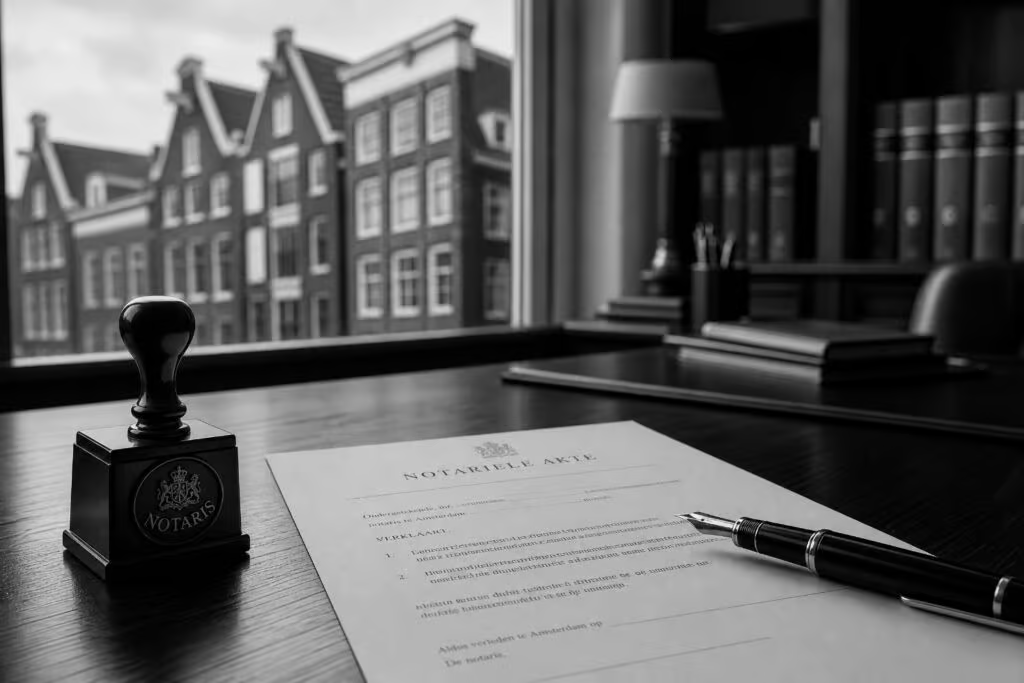
In the Netherlands, the legal transfer of a residential property is handled exclusively by a civil-law notary (notaris), who prepares the preliminary purchase agreement (voorlopig koopcontract) and the final deed of transfer (leveringsakte) both of which are binding legal documents under Dutch law.
Your offer was accepted. The seller said yes. You are excited, maybe slightly terrified. Now what? In the Netherlands, ‘accepted’ does not mean you own the property yet. Unless the seller is a professional real estate investor or company. There is a specific legal process between acceptance and keys and it moves on a fixed schedule. Here is what to expect.
Step 1: The Preliminary Purchase Agreement (Voorlopig Koopcontract)
Within a few days of verbal acceptance, the notary usually chosen by the buyer in Amsterdam drafts the voorlopig koopcontract, or preliminary purchase agreement. Despite the word ‘preliminary’, this document is legally binding once signed by both parties. Outside of Amsterdam normally the selling agent drafts the contract.
The agreement covers the agreed price, the transfer date, all resolutive conditions (ontbindende voorwaarden) such as financing and structural survey, and any specific agreements made during negotiation. Read everything before you sign. Once signed, withdrawing without triggering a resolutive condition means paying a penalty typically 10% of the purchase price.
Mr. Broker reviews every koopcontract before his clients sign it. The fine print matters and it is all in Dutch. This is part of the standard service at Mr. Broker.
Step 2: The Three-Day Cooling-Off Period
After signing the voorlopig koopcontract, the buyer has a statutory three-day cooling-off period (bedenktijd) during which they can withdraw from the purchase without penalty or explanation. This right applies to buyers only, not sellers. The three days are calendar days, not business days weekends count.
The cooling-off period is there for a reason. If you discover something critical in the first days after signing something your broker missed (not us), something you missed this window is your exit. After three days, the resolutive conditions in the contract are your only legal exit route.
Step 3: Resolving Conditions and Transfer Day
If you included a financing condition (financieringsvoorbehoud), you typically have three to six weeks to confirm your mortgage is approved. If the bank does not approve, you can invoke the condition and exit the contract without penalty. The same applies to a structural survey condition (bouwkundige keuring) if the survey reveals defects above the agreed threshold. In Amsterdam it is common to execute the technical survey before you sign the contract or in the cooling-off period.
Once all conditions are resolved, the transfer date is fixed. On that day, you go to the notary’s office. The notary reads the leveringsakte (deed of transfer) aloud, both parties sign, you pay the remaining purchase amount (the deposit or bank guarantee was paid earlier), and you receive the keys. You are now the legal owner.
The full cost breakdown including notary fees, transfer tax and other buying costs is in the FAQ. Transfer tax is currently 2% of the purchase price for owner-occupiers.
Who chooses the notary in the Netherlands?
In Amsterdam, it is customary for the buyer to choose the notary. You are free to use any registered civil-law notary (notaris). Mr. Broker works with several English-speaking notaries in Amsterdam they can communicate throughout the process in English.
How long does the process take from accepted offer to transfer?
Typically six to eight weeks, depending on the conditions in the contract. If you need a mortgage, the mortgage process usually takes three to five weeks. With a trusted network and good preparation this can be arranged earlier, and so you strengthen your negotiation position. The transfer date is agreed between buyer and seller during negotiation it can be shorter or longer depending on circumstances.
What is a bank guarantee and do I need one?
After signing the koopcontract, you are usually required to provide either a 10% deposit or a bank guarantee for 10% of the purchase price. The bank guarantee is a document from your bank confirming they will pay the seller if you withdraw without valid grounds. This costs money though, normally between € 250-350 incl. VAT. Sometimes it is therefore wiser to deposit cash money, money you will use for the buying sum anyway. Your mortgage advisor or bank can arrange the bank guarantee.
Can the notary process be completed in English?
The leveringsakte (deed of transfer) must legally be read in Dutch. However, a certified interpreter can be present to translate in real time, or the notary can provide a certified English translation alongside the Dutch document. English-speaking notaries who work with expats regularly are comfortable handling this.
What happens if the seller pulls out after the koopcontract is signed?
If a seller withdraws after the voorlopig koopcontract is signed and no valid resolutive condition applies, they are in breach of contract. The buyer can demand a 10% penalty payment or seek enforcement of the sale through the courts. In practice, this is rare but not unheard of.
The notary process is straightforward when you know what each step means. Mr. Broker walks every client through this from day one. Book a free intake and arrive at your first viewing already prepared.